
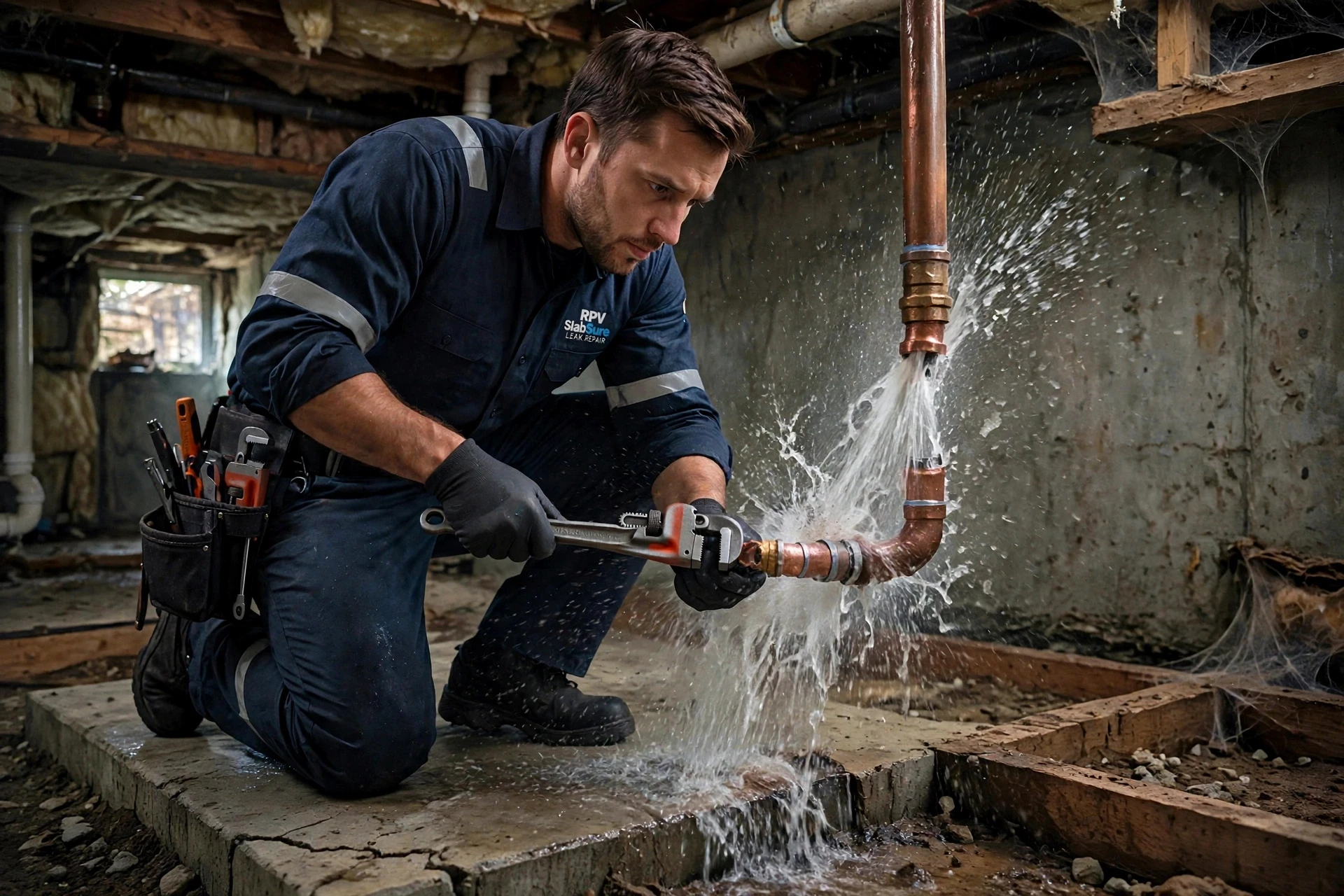
What counts as a slab leak emergency?
Not every slab leak is an emergency — but the line between "schedule this week" and "call right now" is clearer than most homeowners think. It becomes an emergency when water is actively causing damage: spreading across floors, soaking into walls, pooling where it shouldn't, or compromising anything electrical. A slow, stable situation discovered on a Tuesday can wait for a scheduled detection visit; a floor that's getting wetter by the hour cannot.
Emergency slab leak service is built around that distinction. Instead of a routine appointment, you get triage: a dispatcher assesses severity, talks you through immediate shutoff steps, and prioritizes your call against others. The responding pro's first job isn't the permanent fix — it's stopping the water and stabilizing your home. Emergency calls to our RPV team are routed to local contractors who handle exactly these situations across the Peninsula and South Bay.
How emergency response works
Emergency plumbing follows a different playbook from scheduled work. Knowing the sequence keeps you calm and effective.
Triage on the call
The dispatcher will ask what's happening right now: Is water spreading? Can you hear flow? Is anything electrical threatened? Answer plainly — this determines your priority. You'll also get immediate phone guidance, most importantly locating and closing your main water valve.
Stop the water first
Every minute of flow is damage. The main shutoff — usually near the street meter, in the garage, or on an exterior wall — stops the entire system. If you can't find it or it won't budge, say so; the dispatcher will advise alternatives, including the meter-side valve.
Stabilize, then diagnose
On arrival, the technician's first moves are containment: confirming the water is off, protecting unaffected areas, and assessing safety. Only then does electronic detection begin. Skipping straight to demolition in an emergency is how damage multiplies — the diagnostic discipline still applies, just on a compressed timeline.
Temporary control, permanent plan
Sometimes the full repair can't happen at 2 a.m. — parts, permits, or daylight may be needed. In that case the pro establishes temporary control (isolation, capping, or bypass) and schedules the permanent repair — often within days. You'll leave the emergency visit with a dry, safe home and a clear next step.
8 signs this can't wait until morning
Water visibly spreading
Damp areas expanding across floors in real time — the damage clock is running.
Continuous running-water sound
Unbroken flow sounds with everything off mean a significant breach, not a pinhole.
Water near anything electrical
Outlets, panels, or appliances in the wet zone — a safety emergency, not just plumbing.
Total pressure collapse
Fixtures reduced to a trickle system-wide indicates a major line failure.
Water heater can't keep up
Endless reheating cycles on a hot-side breach risk running the tank dry.
New cracks appearing
Fresh cracks in tile or walls during an active leak suggest soil erosion under the slab.
Water coming up through floors
Upward seepage means the ground beneath is saturated — the leak is substantial.
Shutoff won't stop it
If closing the main valve doesn't stop the flow, you may have a pre-meter or multi-source issue — call now.
What turns a slow leak into an emergency
Most slab leaks start small — a pinhole weeping into the soil. Emergencies happen when something changes the equation. A corroded section can give way all at once, converting a seep into a rupture. Water hammer from a quickly closed valve can burst a wall already thinned by corrosion. Soil erosion is the quiet accelerator: as water hollows out the ground beneath the slab, pipe loses its bedding support and flexes under pressure it was never meant to carry unsupported — until it snaps.
External events play a role too. Seismic tremors, even minor ones, shift hillside soils and stress rigid copper at its weakest joints. Construction vibration nearby can do the same. And simple neglect compounds everything: a leak left running for months saturates the ground so thoroughly that the eventual failure floods rather than seeps. The lesson is consistent — small leaks rarely stay small, which is why early detection is the cheapest emergency prevention there is.
What to do right now — before help arrives
Do these in order. Each one limits damage while the truck is rolling.
- Shut the main valve. Clockwise until it stops. Usually at the street meter box, garage wall, or exterior hose bib area. This single action stops nearly all slab-leak damage.
- Protect electrics. If water approaches outlets or the panel, kill the breaker for that area from dry ground — or leave it alone and keep everyone clear.
- Ease the water heater. With the main off for a while, set the heater to pilot or vacation mode so it doesn't fire on an empty tank.
- Move and document. Lift rugs, electronics, and furniture from wet zones; photograph everything for insurance before cleanup begins.
Right now, calmly, go find your main shutoff and make sure it turns. A seized valve discovered mid-crisis doubles the damage. If it's stuck, mention it when you call — it's a quick fix on a scheduled visit.
What happens when the pro arrives
Emergency visits are choreographed differently from scheduled ones — speed first, permanence second.
-
01
Safety sweep
Water is confirmed off, electrical hazards checked, and the affected area made safe to work in.
-
02
Rapid assessment
Quick diagnostics identify the failing line and the scale of the breach — enough to plan control measures.
-
03
Temporary control
Isolation, capping, or bypass stops the immediate threat, even if the permanent fix needs daylight.
-
04
Full detection scheduled
Electronic pinpointing is booked — often within days — to map the exact failure for repair.
-
05
Permanent repair planned
You get the repair options and timeline with a dry, safe home and no more surprises.
Emergency vs. scheduled: what changes the scope
Emergency work carries different economics than scheduled work — here's what's behind it, so nothing surprises you. Our cost guide covers standard pricing factors in detail.
| Factor | Why it matters |
|---|---|
| After-hours mobilization | Nights, weekends, and holidays require on-call crews — ask for the rate structure upfront. |
| Severity & spread | Widespread flooding adds mitigation (extraction, drying) beyond the plumbing itself. |
| Temporary vs. permanent | Emergency control plus a scheduled permanent repair is two mobilizations, not one. |
| Access under pressure | Working around soaked finishes and contents slows every phase of the job. |
| Damage prevented | The real comparison isn't emergency vs. scheduled pricing — it's response cost vs. unchecked water damage. |
Plumber emergency vs. 911 emergency
Call 911 when life safety is threatened: water reaching your electrical panel, flooding that traps occupants, or any situation where someone could be hurt. Call emergency dispatch for everything plumbing — active leaks, burst lines, pressure collapse, and spreading water damage. When in doubt about safety, choose 911 first; the plumber can follow.
If you can't confirm the power is off to a flooded area, stay out of it entirely. Water conducts, and the few minutes saved aren't worth the risk. Wait for professionals with proper equipment.
Emergency FAQs
What should I do first when I discover an active slab leak?
Shut off your main water valve immediately — that stops the damage clock. Move valuables from wet areas, avoid using fixtures, then call for emergency dispatch.
How fast can an emergency plumber reach me in RPV?
Emergency lines are answered around the clock and calls are triaged by severity — active flooding and safety hazards go first. Describe exactly what you're seeing so dispatch can prioritize correctly.
Will the technician fix it on the first visit?
Is a slab leak ever a 911 call instead of a plumber call?
Call 911 for any threat to life safety — water reaching electrical panels or flooding that traps occupants. For the plumbing itself, call emergency dispatch at (310) 555-0100.
Should I turn off my water heater too?
If the leak is on the hot side or the main will stay off for a while, set the heater to pilot or vacation mode so it doesn't fire on an empty tank. Your dispatcher can walk you through it on the call.
What will the emergency visit cost compared to a scheduled one?
After-hours mobilization affects pricing — always ask for the emergency rate structure upfront. But the meaningful comparison is response cost versus the damage unchecked water causes in the meantime.